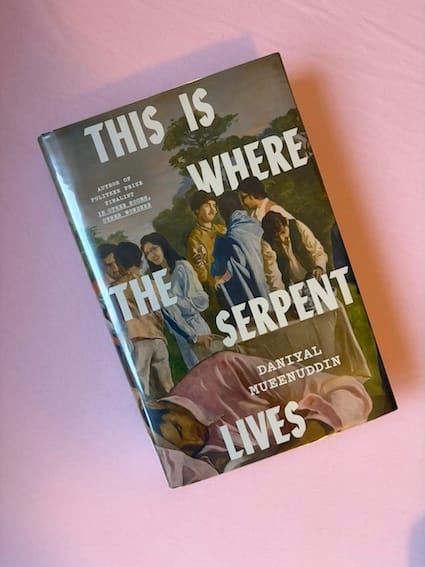
books you may love: This Is Where The Serpent Lives by Daniyal Mueenuddin
A tale of landlords and those in their employ, of characters who have it all and those who desire it all, of finding ourselves desiring a life other than the ones thrust upon us

A few weeks ago, I took a wonderful opportunity to check off an item on my bucket list!
Watch a movie in a theatre all by myself!
One of D's classmates' mom, R, who's also my friend irrespective of whether or not our children play with each other (sometimes they do, sometimes they don't) was my inspiration for this bold step.
A few months ago she was telling me how she set out to watch a movie by herself one Saturday afternoon, taking time for herself away from home while her husband and her son figured out what to do at home. She went to watch Wuthering Heights.
The movie I wanted to watch was Dhurandhar 2. I had watched Part 1 when it came on Netflix a few months ago and had absolutely loved it. So much so that as soon as the movie ended, I went right back to the beginning and watched it once again.
When news came that Part 2 wouldn't stream on Netflix, I knew I didn't want that to be a reason for missing it. So I told KrA that I wanted to go watch it in the theatres, and he was game to hang out with D that afternoon.
And that is how I came to watching a movie in a theatre all by myself. Dhurandhar 2 at the SilverCity Brant Cinemas theatre!
It was a 4-hour movie, which warranted an intermission, which is very unusual for movie theatres in Canada.
I also chose to order a small popcorn and drink combo (iced tea without ice is my favourite!) and ended up eating only half of the bag of popcorn.
Perhaps, sharing a medium-sized bag with KrA normally makes me eat in a hurry, out of fear that KrA would end up eating far more than his fair share?! Haha!
Dhurandhar is primarily set in Pakistan, where an Indian spy infiltrates a local gang with an immense political stronghold in an attempt to thwart attempts of acts of terrorism on India.
The world is not oblivious to the fact that there's been a long-standing history of conflict between India and Pakistan, one that spills over to the holy cricket ground.
But living in Canada, as I do now, I've encountered many Pakistanis in various professions — my family doctor is one, and I trust her with my life and that of my family — who are just as human as we are. Kind, helpful, compassionate, doing what they can to help.
Here, somewhat removed from the conflicts on the India-Pakistan border, it's easier to see each other as human beings, doing our best to make our way through this world in this lifetime.
Shortly after I watched Dhurandhar, I came across the book, This Is Where The Serpent Lives, by Daniyal Mueenuddin in the library.
The blurb goes like this:
Moving from Pakistan’s dazzling chaotic cities to its lawless feudal countryside, This Is Where the Serpent Lives powerfully evokes contemporary feudal Pakistan, following the destinies of a dozen unforgettable characters whose lives are linked through violence and tragedy, triumph, and love.
Orphaned as a little boy and fending for himself in the city streets, Yazid rises to a place of responsibility and respect in the Lahore household of Colonel Atar, a powerful industrialist and politician, only to find that position threatened by conflicting loyalties and misplaced trust.
Born on Colonel Atar’s country estate to a poor gardener, Saqib is entrusted with the management of a pioneering business, but he overreaches and finds himself an outlaw, confronting the violence of the corrupt Punjab Police.
The colonel’s son competes with his cherished brother for the love of a woman and discovers that her choice colors his life with unexpected darkness as well as light.
The book begins with Yazid's story who is abandoned by his parents in a busy marketplace. He's taken in by a stall owner who makes naans and parathas and engages Yazid in his trade.
We see Yazid's interactions with boys from richer families who go to a private school nearby. They gather to play carrom, a tabletop game in which players flick a striker to sink wooden discs into corner pockets.
From there on, the story follows Yazid's journey into the upper echelons of society, his first crush on the sister of one of the boys he plays with, and the realization that he'd never be accepted as one of them.
Yazid's story leads us to another tale of a young Pakistani man, who has returned to his village after having spent several years abroad in educational pursuits. He now needs to manage his ancestral land, which is repeatedly vandalized by an unfriendly faction. Desperate, he sends for some goons from Lahore to teach the vandals a lesson, and ends up finding the goons to be more trouble than they're worth.
The story then jumps to this man's cousin, Hisham, and his exploits in Pakistan and abroad. I forget many of the names now, having returned the book to the library, but I remember being deeply touched by the details that brought all these characters to life.
Some of the sahibs trust their servants blindly. Some servants rejoice in serving their masters. Others face the temptation of stealing from them, just enough to elevate their own station in life without significantly hurting their master's finances.
These day-to-day dilemmas of each character rendered the contradictions of my own inner world so much more acceptable. I loved reading about the simplicity of village life, the labours of farm life, and the constant desire for wealth even when it's obvious that the wealthy themselves go about their lives feeling hollow and shallow within.
And it's all portrayed with much wit, humour and charm!
The principle of using household servants in an executive capacity had been established, strangely enough, by Colonel Atar. Colonel Sahib was old school, meaning he was trained at Dehradun and the Indian Military Academy before Partition, and had absorbed deep in his fibres a respect for British tradition and manners that could still be seen in his upright posture and choleric bearing, his bristling moustache, the silver on his dining table, his fondness for dogs, his shooting and riding, his khakis and tweeds, his accent, and, most significantly, his views of the role and bearing proper to the lower classes.
Plainly Colonel Sahib could not be considered a man of revolutionary principles, and it had therefore been a remarkable day when he took his chauffeur, Bayazid, into his confidence and even into his heart, an organ not notable for its warmth. Perhaps it was his age — the Colonel Sahib was in his graying fifties when Yazid joined his service, as a shaggy genial youth — and perhaps also that Colonel Atar had already then begun to consider himself a man of a previous era, and therefore ripe to assume various eccentricities, including dispensing with niceties of class when it amused him to.
The long-retired colonel began to use Yazid not just as a personal servant, but as a source of information and even advice regarding his businesses, peppering him with questions about the goings-on at Ranmal Mohra and among his factory managers, during their long drives on the old Grand Trunk Road between Lahore and Islamabad, where the colonel intermittently served in government or played an intemperate part in the opposition. Yazid was not a tattletale, took no pleasure in exposing wrongdoing, believed in service and loyalty, and had no ambition to be anything other than a driver. These qualities, which his astute master conceded, gave his words weight.
It was in this context and with this precedent that Hisham — meaning Shahnaz, really — resolved to put Saqib in charge of the new enterprise, reasoning that Yazid would supervise and Saqib provide the energy. Though he was only twenty-one at the time, and looked even younger with his wisp of a moustache and cheeks that barely needed shaving, Saqib undoubtedly had the presence and initiative and intelligence to make a go of it.
"Are you sure? He's smart enough, but isn't he a bit green?" said Shahnaz to Hisham as they sat over toast and marmalade in the dining room at Ranmal Mohra. She had already made up her mind, and now was pretending reluctance as a way of bringing Hisham on board, these almost necessary subterfuges of a wife who for years had been playing three-dimensional chess with her hapless mate quite without his knowledge.
Poor Hisham, as she regarded him at such junctures, could be obtuse. "Perhaps you're right. He's just a kid, and he has no idea of business. Plus, I hate to lose such a good valet."
"Valet? Saqib? Pffh." Shahnaz was elaborately buttering her toast, which she regarded as an art, one that she absorbed as a diplomat brat among the Europeans. "You're not just wasting him packing your suits and making your drinks the way you like them — you'll even be wasting him on your vegetable startup. I still say that boy should be sent to university, if only he knew English. Not that he doesn't, by the way, but I doubt his spelling."
"I suppose he learned it by watching our lips," said Hisham. "Like some super-intelligent dog."
"Dog! You're worse than your Colonel Sahib."
~ An utterly delightful excerpt from This Is Where The Serpent Lives
One of the criticisms of this book that I've seen on Goodreads is that readers find this to be not a novel but a series of loosely interconnected tales focusing on different characters.
That may be so, but in the course of reading the novel, I found it to be a realistic progression, with the story being told from the perspective of one character and then another, unfurling as time and events do.
Stories written by western authors often tend to offer closure, coming back full circle at the end and leaving no loose ends. Everything is neatly explained and tied up and presented like a gift wrapped in sparkly paper and a ribbon with an exquisite bow. There's a sense of completion.
But stories written by Asian authors often leave a lot to the imagination, allowing minor plot points to remain unresolved on paper. I find those are the stories that linger in the mind long after I've finished reading a book.
It's not about a neat conclusion or a tidy resolution. It's about the unfolding of the character's story, their life, which continues long after we've turned the last page.