on books, basketball and on being a rebel as a parent
Life, and books, as they happened ...


How has life been ever since I quit writing and indie publishing fiction? you ask.
Excellent! I reply.
There's none of the anxiety that writing fiction for money had filled my life with for years. Moreover, the lessons I've learnt from those experiences are standing me in good stead now as I pursue a new path for knowledge, for gaining in skills, and for the joy of learning and experimenting, and not solely for proving my worth to myself or to anyone else in the form of wealth, fame or popularity.
I still have a book that's coming out next month! The Folly Of Memory — an immersive metaphysical fantasy novel, the writing of which turned me inside out and compelled me to separate the joys of writing from the necessity of earning a livelihood.
I'm still curious to see how the market receives it.
But, I digress.
I have been reading a number of amazing books recently, and many have touched me so much that I wish to record them somewhere on the Internet. Besides, life has also been frolicking and cavorting, which is almost always the most compelling reason to come back to presence and stories and to this blog.
The first big event was D turning 10 this month. Something about the double-digits that marks a clear break away from the single digits that will never be used to mark his age again tugs at the heartstrings.
I remember feeling similarly when we stopped referring to his age in months and resorted to marking it in years instead.
A dear friend of mine gifted D a selection of books from the much beloved Wings Of Fire series, the graphic novels. D bought the remaining to complete the collection to date.
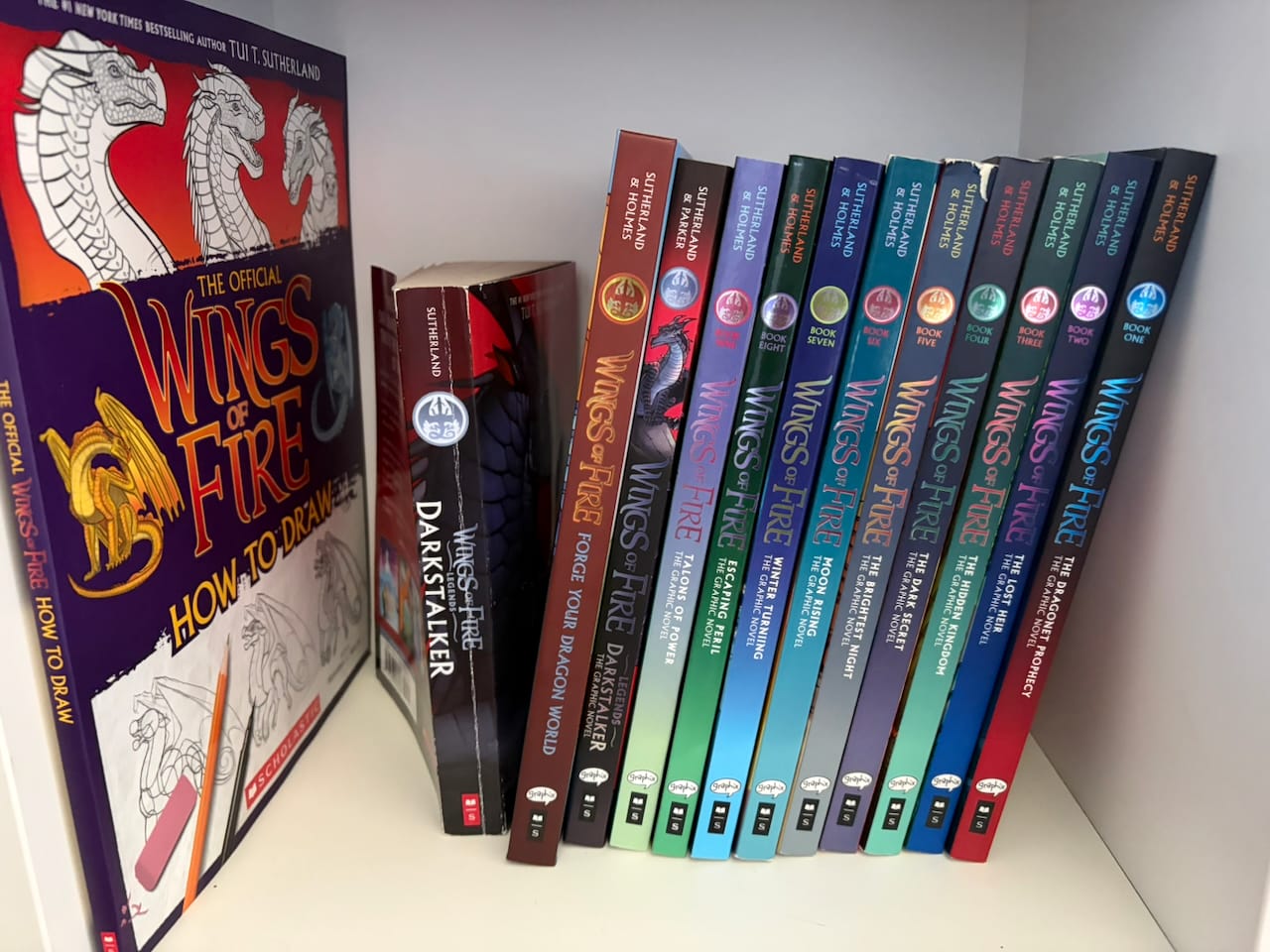
The last I had written about our ongoing reading of this series was when we finished reading Book #7, Winter Turning, the chapter book version.
Since then, we've read Book #8, Escaping Peril, Book #9, Talons Of Power, and are now in the thick of reading #10, Darkness Of Dragons.
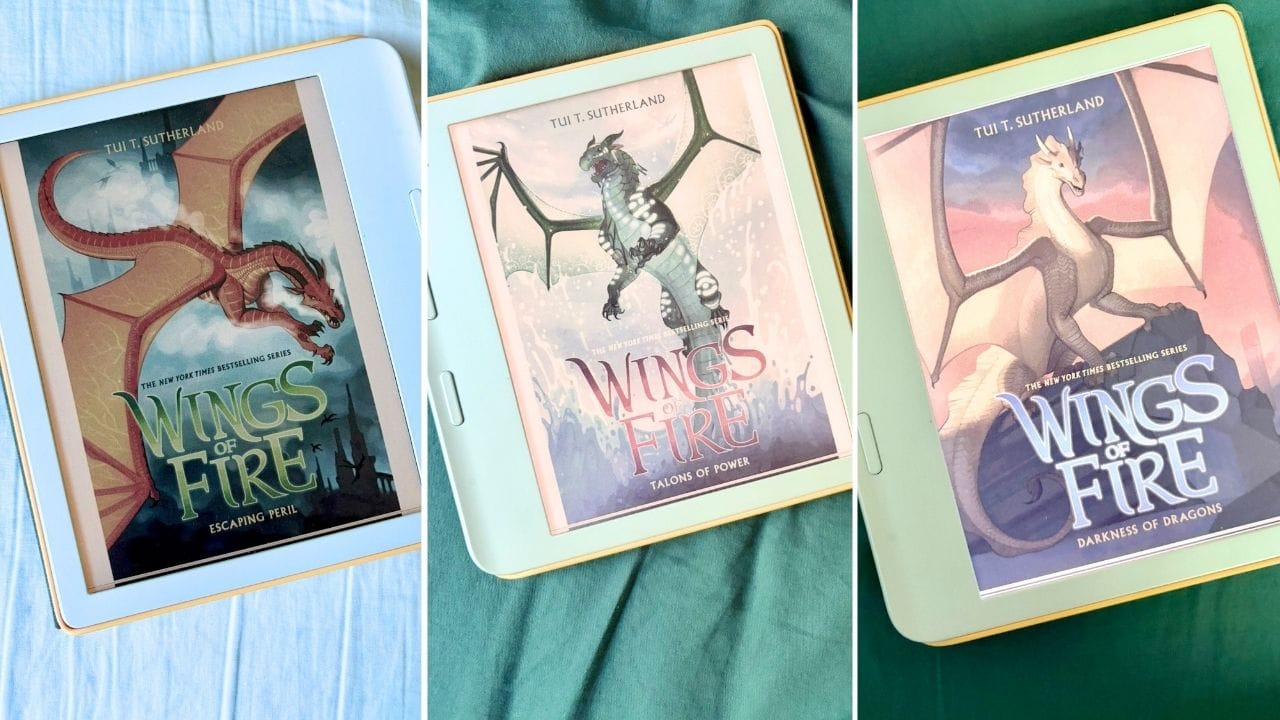
Escaping Peril was a difficult book to read for me. Peril is completely obsessed with Clay and appears to be a dragon who's unable to think for herself, because her worldview has been thoroughly warped by Scarlet, the erstwhile Queen of the SkyWings.
Reading the book from Peril's point of view, with her constant self-doubt and worries about what would Clay think about this or that made me very uncomfortable.
But that is probably what Sutherland set out to do, and does it brilliantly. Because Peril is that kind of character.
And, to be fair, we're given adequate warning of it in Book #6, in which Moon the mind-reading NightWing often discovers that Peril's mind is very messy and complicated and difficult to read.
Funnily, I love how Peril's character turns out to be in the subsequent books. More sure and confident of herself, providing unexpected comic relief on occasion, and definitely having grown from a dragonet needing validation and approval all the time to becoming more comfortable in her own skin.
Talons Of Power was another amazing read, this one from Turtle's point of view. A SeaWing animus dragon, he hides himself from DarkStalker, an ancient dragon who's been mind-conversing with Moon since Book #6 and rises from under the earth at the end of Book #8.
Many dragonets are taken with DarkStalker who tries to present himself as a charming ally rather than the mad, animus magic-wielding monster history has painted him to be.
Turtle, having used his own magic to render himself invisible to DarkStalker and immune to the latter's magic, is the only one who sees through the dragon's evil intentions and has to be the one to do something to stop the ancient dragon.
The only trouble is Turtle has kept it a secret from everyone that he's an animus dragon and can wield magic. How that secret unravels and how Turtle deals with it is fascinating.
In this excerpt, Turtle has informed his sister Anemone and a RainWing friend who's blind, Tamarin, about the return of DarkStalker. They still don't know that Turtle is an animus.
Like Tamarin's eyes. I could fix them. I could do it right now... I could enchant that bandage so when she takes it off, she could see for the first time in her life. That was the kind of thing he wished he was free to do, and it felt awful to have to stop himself.
But he still figured it was a lot easier to be a secret animus than to be an animus everyone knew about.
"I wouldn't want to be an animus," Tamarin said. She paused at a spot where the tunnel branched into three directions. "I don't know how anyone could stay a good dragon with all that power."
"What if they only used it for good things?" Turtle asked, a little stung.
"But who gets to decide what's a good thing?" Tamarin asked. "Dragons would always be asking for spells, or telling you your choices are wrong. And I think sometimes it's hard to tell what's good and what's just easy."
Turtle gave her a puzzled look. "Aren't those the same? What's wrong with trying to make life easier?"
"It depends," Tamarin said. "For instance, an animus dragon might think, I'll make all our medicinal herbs appear magically in the healers' treehouse, so we never have to go looking for them again. That seems obviously good, right? But then we'd stop learning how to look for them, and we'd stop experimenting with new ones to see how those might help dragons in different ways. We'd stop thinking about it at all, because everything would be too easy. Don't we lose something when everything is done for us?"
~ An excerpt from Talons Of Power, Book #9 in Wings Of Fire series
I'm simply amazed at how Sutherland manages to keep so many story threads connected and weaves many past storylines seamlessly into tales about all these new characters.
The other thing about D growing older is the expansion of the life experiences he faces, which calls on me to be more stable and grounded as I help him navigate them.
He wanted to dip his toes into competitive sports and decided to attend the tryouts for rep basketball. Even though I love basketball and played it for a few years at university, old insecurities were triggered as I took little D to the tryouts.
Before we went, though, we had decided that our Success POV this time was going to be to show up and do our best. We had decided that whether he gets selected or not is not going to be a success criterion this time, as this was the first time ever that he was heading to a tryout.
He didn't get selected this time, but it was such an eye-opening experience for him that his game on Day 2 of the tryouts was a huge step above how he played on Day 1, when he was nervous and unsure of what to expect. So this was a huge step forward in his journey.
Something strange happened, which makes me feel grateful that he wasn't selected to this particular team.
On the second day of the tryouts, one of the coaches saw D coming in to the registration desk and said, completely out of the blue, "Jeez! Where's the confidence, man? Did your parents have to pull your teeth to bring you here?"
As always, I was too stunned by those unexpected words to say or do anything in response. It was only after a few moments did I understand how judgemental and demeaning those words were.
D is naturally a quiet kid. He's not one of the gregarious ones that N. America seems to love.
But if a coach can't understand that a new player might be nervous before a tryout, well ... is that the coach I want teaching my child?
My answer is a definite No!
I wonder if people in the sports world here in North America know where to draw the line between competition and aggression.
I read this in a book somewhere, and I'm glad I found an online resource to back up this claim, but did you know that Norway doesn't permit competitive sports until the age of 13? And it's the nation that wins the most medals in international sporting events!
 Chad Henry
So here's me being a rebel mom. I'd much rather D have time to practise the piano, go skiing in the winter, go for a fun swim over the weekend, have time to enjoy bike rides in the summer, have a lot of time to read books ... instead of spending 4 days a week training for rep basketball and both days of the weekend playing games during the season.
But ultimately, the choice is up to D. Whatever he decides, I'll support him through that.
Yet, it was D who took the news of his non-selection in his stride. And it was I who went through an entire gamut of emotions, worrying that my own fears about this would spill over and affect my ability to help D cope.
I'm getting better at this, though. When D was younger, I was very enmeshed with him. His pain would ratchet my anxiety up to unimaginable levels.
Now that he's older and I've had sufficient time to come to terms with the fact that his life will unfold in its own ways,
that it's not a hapless infant that will have to face the challenges of life
but a 10-year-old, a 15-year-old, and the future adult version of him that will meet life's experiences as they come his way.
It's easier to return to that trust and faith these days than it had been when D was much, much younger. And that comes as a relief. To be able to meet life's moments without being beset with anxieties of the future all the time is a welcome change.
Which makes our nightly bedtime routine of reading the Wings Of Fire series together all the more magical.
I thought my days of reading to D had long gotten over. It's so much fun at this stage of his life to be able to read with him and question and digress into discussions about why a particular character did something or made a certain choice.
Books and stories make a huge difference in our lives, and I'm extremely glad that D takes after me in being such an avid reader.
Another interesting book I read was The Man Made Of Smoke by Alex North. It's about a serial child kidnapper and killer, one that our protagonist encountered as a young boy, and now again as an adult perhaps it is the same villain who has resurfaced.
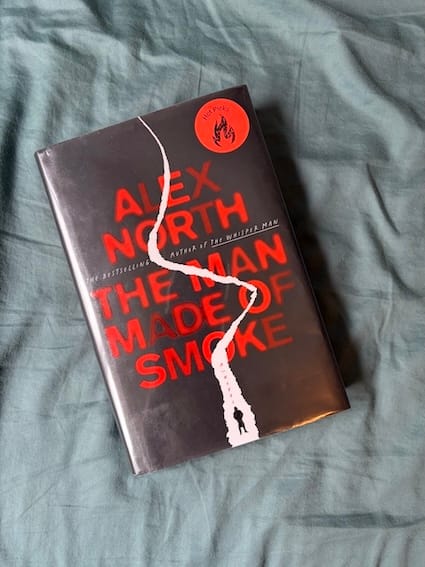
For a serial killer story, the book had many thoughtful and poignant lines, many of which I re-read several times. I had dogeared several pages, then forgot to photograph them before returning the book to the library.
I managed to save one passage though.
"Do you think you were abducted from the bar?" John says.
Field nods cautiously.
"I left my drink inside when I went out to smoke," he says. "Someone could have spiked it then. I don't remember much after that."
"Why did you leave your drink?"
"You don't worry about it as a guy, do you? The place wasn't all that busy, and I had a table out of the way round a corner that I wanted to keep. I didn't want to talk to anyone there."
There's a helpless expression on his face.
"I just wanted to sit with my phone. That was all I ever did. Catch up on the news a bit; read a few updates on social media. Maybe play a few games of chess if I couldn't get reception."
He spreads his hands, the question clear.
Is that too much to ask?
The answer, John thinks, is that it shouldn't be, but that's not the way things work. If you let your guard down once, the chances are that you'll be okay. But if you do it a hundred times, the odds are going to catch up with you eventually. Which to his mind is more than enough reason to keep your guard up the whole time.
~ An excerpt from The Man Made Of Smoke by Alex North
Another amazing book I read was Ghost-Eye by Amitav Ghosh. Wow! I have no idea how to begin describing this book.
It delves into the theme of reincarnation, and somehow also blends local folklore and deities and superstitions and environmental crisis into the mix, and unfolds across North America in the present day and India, specifically Kolkatta, in the 1970s! What a delight it was to spend a good amount of time in that era!
And Ghosh has described the fish dishes in such fine detail that I'm now hankering to try some fish. Me — a born vegetarian! And I want to try a Bengali fish dish!
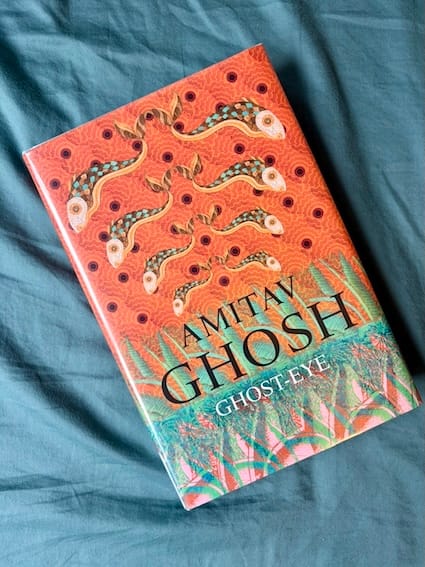
Many parts of this book resonated with me deeply, often for vastly different reasons!
For instance, the passage below helped me make peace with my own lifelong disinterest in the kitchen, which caused much conflict with my mother-in-law. But in the last few years, cooking has become an activity that I turn to with much affection and joy. The Instant Pot made that happen! 🤷🏽♀️
This too was a point of contention between Shoma and her older sister. My mother took great pride in her cooking and thought it shocking that her sister showed so little interest in her kitchen. 'What is there in life that is as important as food?' Ma liked to say. 'Food is the foundation of life itself; it's what makes everything else possible. But someone who lives in their head, like Shoma does, can never understand that food is what connects us with reality.'
Often when Shoma came over to our house for a meal my mother would tease her by asking if she knew what kind of fish she had been served. And if Shoma got it wrong, which she invariably did, my mother would huff triumphantly. 'You call yourself a Bengali but you can't even tell the difference between putti and pabda! Chhi!'
These barbs would miss their mark because Shoma was not at all ashamed of her culinary shortcomings; on the contrary she took pride in having liberated herself from the drudgery of the kitchen—an idea that would have been incomprehensible to my mother, who never felt more free than when she was cooking.
~ An excerpt from Ghost-Eye by Amitav Ghosh
This passage helped me release all the shame I had held on to for several years owing to my culinary shortcomings. Unlike Shoma, I hadn't been able to ignore my mother-in-law's barbs for a long time because I was so desperate for her affection and acceptance.
Well, that was several years ago. I'm now old enough to understand that I can't expect to receive from others what I'm unwilling to give myself and especially when others don't know how to give it as well. Now, I'm in a better place of understanding and acceptance and it makes for a happy balance.
And here's another excerpt that doesn't need a context to explain the sentiment expressed in it.
Tipu snorted exasperatedly. 'Jeez, Pops, you really don't get it, do you? Do you think these abilities come from the brain? If so, you're wrong—that's not it at all. They come from inside you, from your body, from your senses. That's why these guys who think machine intelligence can replace human thinking are so mistaken. AI just mimics the brain, and that's not where we get our forebodings and premonitions and all the other things we humans can feel—the stuff that gives us goosebumps and makes the backs of our neck prickle ... All of that comes from the body, the flesh, everything that gives us our humanity. The brain only gets in the way. That's probably why Dev chose to be illiterate—his relationship with his nat is more important to him than anything he could learn from books.'
~ An excerpt from Ghost-Eye by Amitav Ghosh
And here's an excerpt with a folklore and an understanding of what it means to be disenchanted as an adult and lose that naïve faith we may have had as children.
The legend that Shoma had chosen for me is, at its core, the story of a profiteering merchant called Chand who finds himself locked in an epic struggle with Manasa Devi, the goddess of snakes. The goddess reveals herself to Chand, expecting to claim him as her devotee, but the merchant refuses to submit, thereby inviting her wrath, and so she punishes him with plagues of snakes, droughts, storms and other calamities until he is forced to flee overseas. She then turns her wrath upon his son, Lakhindar, and sends her kala naag, the great king cobra, to kill him. Lakhindar dies but is brought back to the world by his devoted wife, Behula, who travels to the underworld, like a Bengali Demeter, and prevails on Manasa Devi to have pity on him and on her.
Only when I started writing the proposal did I realize how deeply the legend was implanted in my mind. When I was a child episodes from the story were often narrated to my sisters and me on those dark Calcutta nights by Shoma and my mother and many others. The story's characters peopled my dreamworld; they were the equivalent of the superhero, werewolves and vampires on which the children of today are weaned. Like these other fantastic beings, the characters of the legend turned the world into a place where anything was possible and nothing was beyond imagining.
Of course, my childhood was long behind me by the time I decided to make the legend the subject of my research. Not only was I an adult, but I was also a deeply disenchanted one, and I took comfort in a certain kind of dogmatic materialism, especially the belief that nothing existed that could not be verified by empirical methods.
So, just as Shoma had suggested, I treated the texts as storehouses of data, as elements of a superstructure that mechanically reflected the underlying realities of the Asiatic mode of production. This was a comfortable approach because it stripped the story of any element of mystery and made it conform to the expectations of an academic system that was premised on making everything in the world predictable and subject to control.
And as Shoma had foreseen, it worked. One day I found myself opening with trembling hands something that was new to my experience: a letter of acceptance.
To say that I was overjoyed would be an understatement. I could not believe my good fortune! The first thing I did after putting the letter down was go to a public call office to phone Shoma. 'You were right!' I said. 'I've been accepted, and it's all because you chose that legend for me!'
'No, no, Dinu!' she protested. 'Trust me: it's not we who choose the myths that guide our lives; it's they who choose us. But once you've been chosen, beware, because they'll always be with you.'
~ An excerpt from Ghost-Eye by Amitav Ghosh
These lines reminded me of my own faith and awe in the stories of the Gods of my childhood. I held unshakeable faith in the deities I grew up worshipping, until one day I stopped.
I remember thinking that I didn't wish to pass on my faith to D blindly; I wanted him to be able to choose for himself.
I also remember feeling strange at the realization that all the prayers I had learnt were in pursuit of some material gratification — first rank, wealth, job, successful visa applications ... whereas what I really wish I had asked for was happiness and contentment despite how life turns out.
Anyhoo, Ghost-Eye was an absolutely delightful book to read! I'm also surprised that I haven't read any other works by Ghosh, so looks like I'd have to do something about that pretty soon.
June was memorable for yet another event this year. We attended the Senegal vs Iraq game of the FIFA World Cup in Toronto!
Back in 2022, we were watching the previous World Cup on TV just as this part of the world was returning to some semblance of normalcy after the pandemic. When Canada was announced as one of the co-hosts of the 2026 World Cup, I remember messaging several of my friends and beseeching them to plan to make a trip here so we could watch a game together.
None of that materialized but a year ago, KrA dove into the multi-step process of securing tickets.
It was quite a fun experience, and we got to see Senegal score 5 goals! But above all I loved being in a train and then in a stadium filled with people who families originated from Iraq and Senegal. Something like that is possible only in Canada!
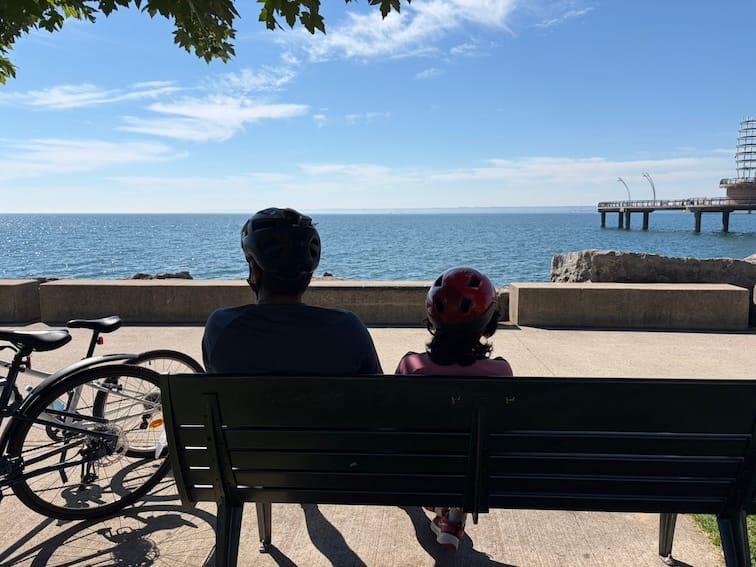
I love this place! And I love Burlington! Where else can I spend a Sunday morning in summer on a bike ride with KrA and D to the shores of Lake Ontario, then come back and pluck mulberries from roadside trees for a juicy snack to sate our thirst?