how much do stories really matter?
A reflection gleaned from author talks I attended at the Burlington Public Library's 5th annual Literary Festival this month
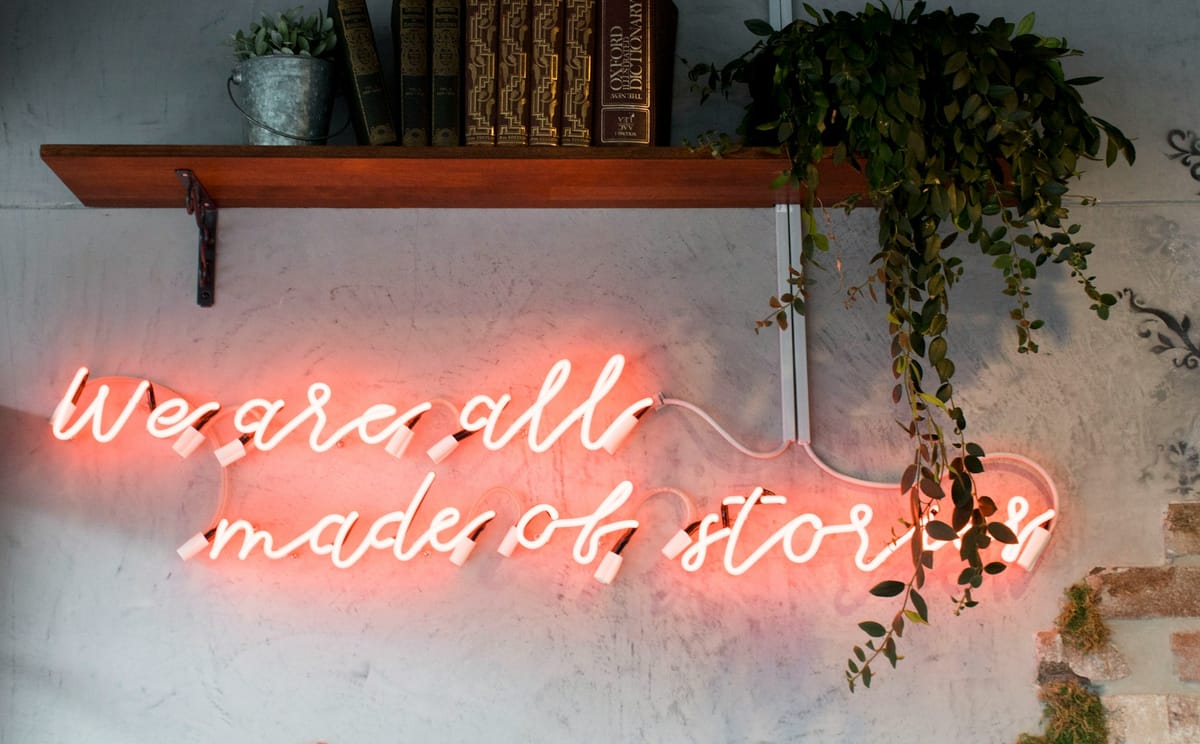
So much of who we are is shaped by the stories we tell ourselves — about ourselves, about other people, and about the larger world around us.
It is often said that writers write and readers read in order to figure out what we think and how we make sense of the world around us.
I first put pen to paper — when there wasn’t an academic requirement to do so — to write a poem about the state of my heart when I finally came to realize that a particular relationship had well and truly come to an end and that I had no other choice but to move on.
As much as the situation birthed the poem, it was also the writing of it that led to the resolution of the inner conflict and turmoil that were wrecking my 21-year-old self at the time. (That was more than half a lifetime ago!)
Fast forward to recent times. When the indie publishing landscape erupted, several experts whose advice I used to heed took to saying that stories are all about escapism and that readers only want a few hours of entertainment and that our job, as writers, is to provide them that.
Really? Is that all there is to it?
Something about this school of thought simply did not sit well with me. It made it sound as though writing was equivalent to peddling drugs. A pill to deliver an instant high and make the user reader keep coming back for more.
It also didn’t feel like the complete truth.
I read for respite from the world, yes, but I also read to experience lives I don’t have the time to live in whatever timeframe I’ve been blessed with in this lifetime. I read to understand different perspectives, hear from a multitude of voices, and appreciate varied ways of life.
I read to keep my heart open to the possibility of a world where bravery, courage and loyalty matter, where compassion overrules cruelty, and where we are at least able to understand the context that underpins the motivations and actions of people around us, the stories they tell themselves about everything, the stories that make them who they are, no matter how completely different they are from us.
And isn’t it true that every story we read, every experience we have, changes us irreversibly in some way? Perhaps it’s a subtle change. Perhaps it’s the kind of change that thrusts us upwards from rock bottom.
It’s a shift, nonetheless. A different way of thinking. A new path to follow consciously. Isn’t it?
It was with these questions and thoughts burning in my head and heart that I attended several talks by renowned writers at the Burlington Public Library’s annual Literary Festival this month.
A few impacted me so deeply I simply had to capture those thoughts in words and share them here.
Why Everyone Should Read Science Fiction by Robert J. Sawyer
The first talk I attended was by Robert J. Sawyer, known as the Dean of Canadian Science Fiction and with many awards and records to his name, on Why Everyone Should Read Science Fiction.
I’m rarely drawn to science fiction as a genre, which is why I attended this talk, which turned out to be very illuminating and captivating.
Sawyer began by asking the audience what they believed was the origin of science fiction. The most popular answer was The War Of The Worlds by H. G. Wells, first published in 1898.
Sawyer explained that it has been widely established and accepted in literary circles that Mary Shelley’s Frankenstein, published in 1818, marks the origin of science fiction given its premise of a scientific experiment.
Sawyer further went on to explain how this particular tale can be viewed through a sociopolitical lens as an exploration into what could possibly happen if men, living in a society in which women’s place was restricted and confined to traditional roles, usurped the one function that only women were capable of — giving birth to new life and nurturing it.
I had never looked at the story that way! Sawyer further went on to explain how the story sheds light on the innate differences between men and women when it comes to nurturing — after all, Victor Frankenstein abandons his creation and flees.
I later remembered having read Mary and The Birth of Frankenstein by Anne Eekhout, translated into English from the original Dutch version by Laura Watkinson.
It’s a touching fictional narrative told across two timelines — Mary Shelley’s adolescence, and a period of time spent with Lord Byron and his companion John Polidori in Geneva while grieving the loss of her child and indulging the men in a challenge to write a ghost story.
Another example that Sawyer gave (he gave several, but these are the ones I remember now) of science fiction being used as an instrument of societal change was that of H. G. Wells.
He mentioned how Wells was anti-colonial in his beliefs at a time when the British were plundering the world and adding whatever patch of land they could claim to their empire.
While an outright criticism of the empire’s actions would have met with opposition at best or indifference at worst, Wells purportedly used the medium of fiction to get his readers to think about what it would be like to be on the receiving end of colonialism.
Sawyer also noted something interesting in how science fiction stories have evolved over the past several decades.
In the 70s and 80s, the science fiction that young adults were reading were very optimistic and that shaped how these readers viewed their future. Now, however, it’s largely dystopian science fiction that abounds, leaving young readers with a bleak and rather dismal view of their future or reinforcing those beliefs they probably already hold.
When asked about the difference between fantasy and science fiction, Sawyer answer’s came as a flash of brilliance.
Fantasy is what could never be. Science fiction is what could possibly be.
And isn’t that true? Many scientific/technological advancements being made have already been extensively explored within the realms of science fiction, as Sawyer pointed out.
It was such an illuminating and inspiring talk that I’ve already decided to add more science fiction books to my reading list. Any recommendations?
In Conversation with Patty Krawec
Another author whose event I attended, sitting utterly riveted and completely present as she spoke, was Patty Krawec, an Anishinaabe-Ukrainian writer, activist, and former social worker.
Of the many enlightening things she talked about in conversation with the library’s events coordinator, Parampreet Khanuja, one that stuck with me was that the term ‘Indigenous’ is actually an analytic, a term bandied about for political discourse, but it’s not the name of an overall community.
She also shared how different the language of the Anishinaabe people is compared to English. English is largely a noun-based language, objectifying and labeling things and people, whereas the language of the Anishinaabe people is verb-based in which ‘nouns’ are described through processes or actions.
For instance, a ‘chair’ would be described as ‘something to sit on’. In another dialect, it may be referred to as ‘something to put your bum on’, enabling people speaking different dialects to understand each other.
Krawec also noted that the language of the Anishinaabe people didn’t have words for the incarcerated. No one was called a ‘thief’ or a ‘murderer’. There are words to describe them as ‘a person who stole something’ or ‘a person who killed someone else’.
But to call them a ‘thief’ is to essentially reduce their identity to that one singular action that goes on to define them for the rest of their lives, completely ignoring the truth that this is a person who has done other things too.
This reminded me of something that Brené Brown has written about, that we make good or bad choices, and that these choices don’t define us as good or bad people.
This is something we practise at home too. Because if we label ourselves ‘bad’ for having made a poor choice, we’re not letting ourselves make mistakes and learn from them, are we?
Another beautiful concept that Krawec shared was to not begin a story with ‘Secondly’. Which means that when we don’t talk about what came ‘Firstly’, we fail to provide context to what happened next i.e., what is described in the paragraph that begins with ‘secondly’, and that leaves readers/listeners with an incomplete understanding of the events that precipitated into the incident being discussed.
She gave an example of how in western movies, the conflict in the story often begins with a native person attacking a seemingly peaceful community of white inhabitants, prompting the lone ranger to head out and protect his people from that invasion.
This is an example of beginning a story from ‘secondly’. Because no one pauses to think or talk about what prompted the native person to attack in the first place — the answer to that is obviously the plundering and usurping of their land by white settlers, but not highlighting that context paves the way for an incomplete and often wrong narrative to entrench itself in the minds of people.
In the context of human history fraught with conflict, Krawec said something very powerful:
Violence is not the answer but it is often a solution. Non-violence is a privileged course of action.
I came back home and shared this with KrA, and we got to discussing about Indian’s movement of non-violence to overthrow the British colonial rule. Would it have succeeded had Britain not been weakened by World War II? That’s a question that can only be answered in a parallel universe.
When it was time for the audience to ask questions, I asked Krawec who she considered to be the audience of her work.
My question was in the context of how when H. G. Wells, himself being a white British man, was in a position to speak out effectively against colonialism; he had an audience in his peers and other white people would likely hear him, give him the time of day, even if they didn’t agree with him.
But who, outside of marginalized communities, is actually taking an interest in the stories and efforts of these communities?
The question I really wanted to ask, but couldn’t quite phrase it like that out of fear of hurting someone was this: The people who need to hear these messages are not in the audience. Then how do we ensure that these important stories we tell fall on their ears and compel them to challenge the misguided beliefs they’ve been holding on to about marginalized communities, often without even realizing it?
Krawec’s humble and honest response was that she creates her works primarily for herself and her community. If her writings happen to make an impact beyond that, that’d be great. But if not, it was still important for her to tell her story and for her community to feel seen and heard in her works.
I wanted to run up and give her a hug for saying that. Because, at the end of the day, we can only speak our truths, knowing that it is one of a multitude of perspectives out there. How it lands, how it is received, whether it has the desired impact of inclusion and equity in terms of compelling the powers-that-be to challenge the narratives they may have grown accustomed to and to take effective actions going forward, is not in our hands.
Krawec ended her conversation by saying, “Read widely. Read deeply. Read radically.”
Krawec’s interview was perhaps the very first event I’ve attended by an Indigenous author. One person who really inspired me to do so, that too unknowingly, was the Burlington Public Library’s Events Coordinator, Parampreet Khanuja.
At the beginning of every event, before introducing the speaker, Parampreet reads out the Land Acknowledgement, and he goes on to add that in addition to reading out those few sentences, he likes to think more deeply about what he could possibly do to embody the spirit of the acknowledgment.
That statement of his stayed with me. So even though that Monday had already been a long, long day for me and I was very tempted to not show up to Krawec’s talk, I was determined to attend it. It was such an enlightening talk and I was really glad to have had the opportunity to hear Krawec speak.
Celebrating Jane Austen's 250th by Catherine Little
Another event I attended was Celebrating Jane Austen's 250th by Toronto-based author, Catherine Little, who writes picture books to introduce authors of classics to the present generation.
Little spoke about Jane Austen at the event in honour of this year being the 250th anniversary of Austen’s birth.
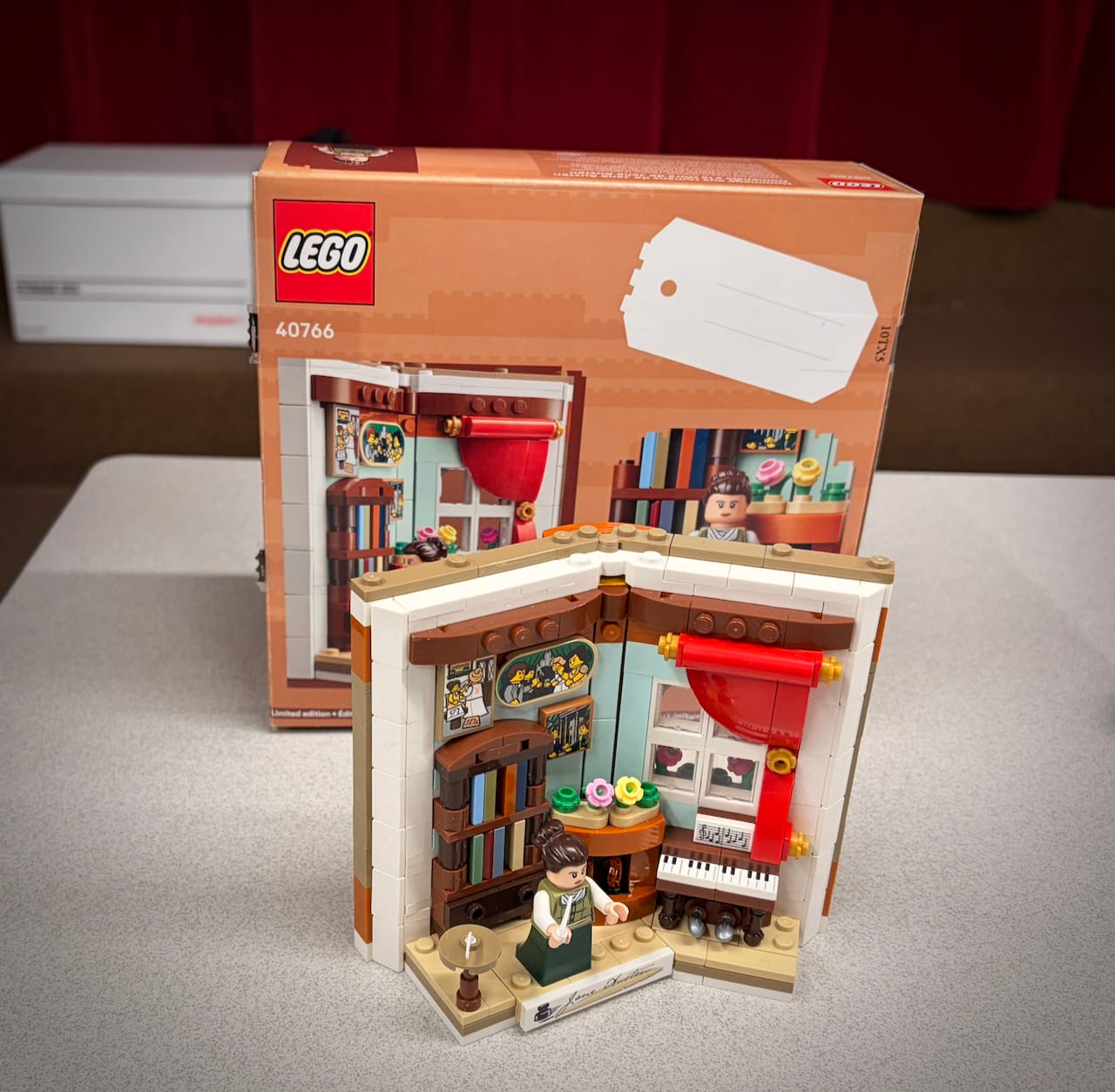
Apparently, as Little revealed, the only author ever to have had a LEGO set made to honour her is Jane Austen!
Isn’t it insane how women across so many generations continue to swoon over Mr. Darcy? And how enduring these stories are — stories about ordinary people like you and me in sometimes ordinary, sometimes extraordinary situations?
That is why stories, to me, are far more than entertainment. They are illuminating. They are inspiring.
Above all, they encourage us when we feel scared, lift our spirits when we feel low, and remind us that at the end of the day, we’re all really made of stardust and the narratives we believe and the stories we tell about ourselves and about everything and everyone else.
If you loved this reflection and would like to stay in touch, sign up for my free newsletter, Monthly Missives from The Dream Pedlar, for musings on the joys of writing, reading and living the creative life.