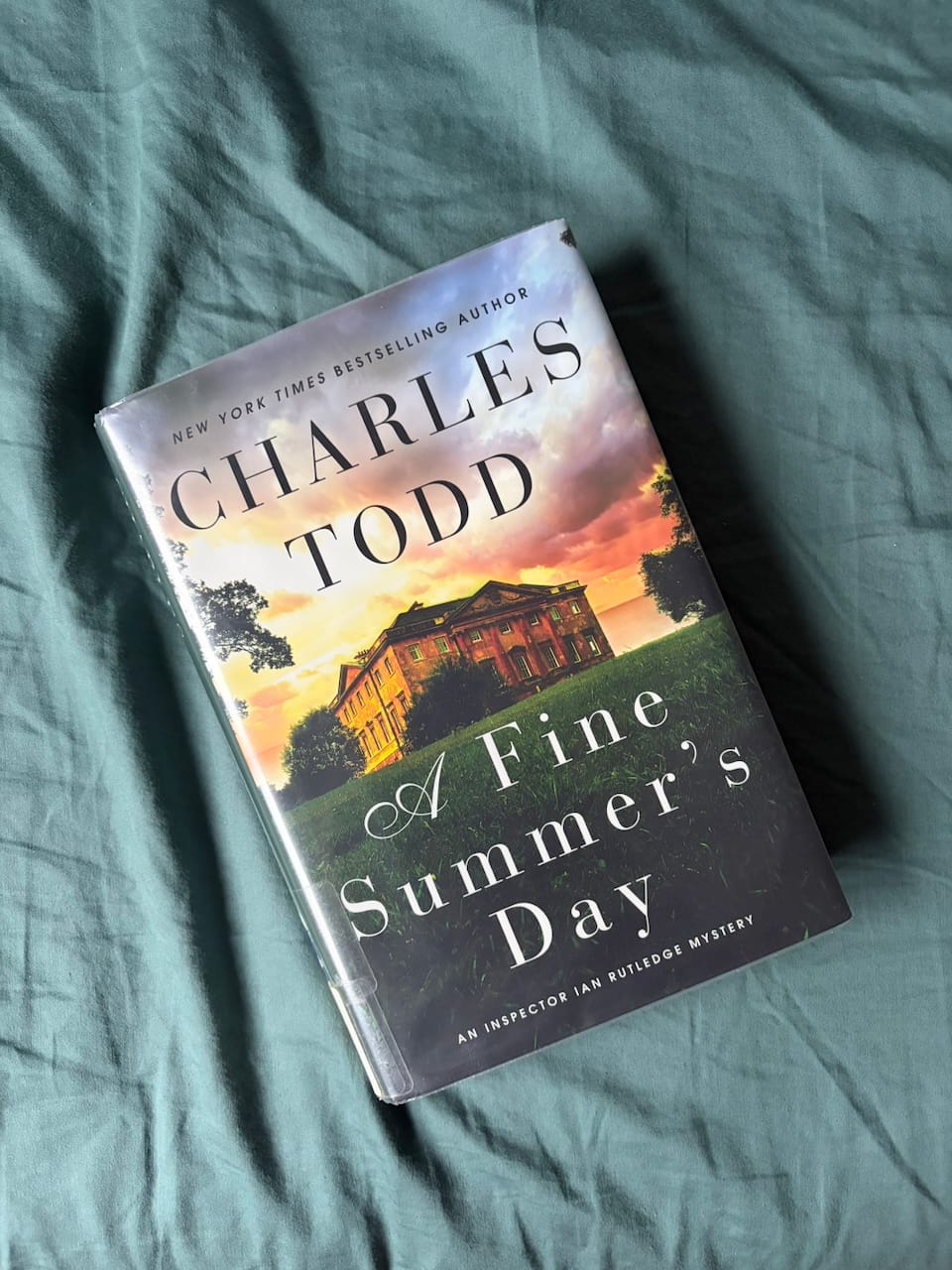
books you may love: A Fine Summer's Day by Charles Todd
Musing over the nature of relationships and quiet heroism in this reflection on the prequel to the Inspector Ian Rutledge series of historical mysteries


If you've been around in these parts for any length of time, you'd know by now that Charles Todd is one of my favourite authors. Their Inspector Ian Rutledge series and Bess Crawford series, both set in and around WWI, are comfort reads for me.
Written with great empathy and sensitivity, these murder mysteries set against the backdrop of the war and its effects on people, soldiers and civilians alike, are convoluted, character-driven mysteries.
I've mostly read these series out of order, grabbing whichever books were stocked in the library shelves or whenever a hold request became available. I also pick these books without paying much attention to the blurbs, only checking the titles cursorily to ensure I haven't already read them. I rarely ever re-read a book.
Imagine my delight when I realized that A Fine Summer's Day, Book #17 in the Inspector Ian Rutledge series, is in fact a prequel to the entire series! It is set in the summer of 1914, beginning with the assassination of Archduke Ferdinand, and unfolds with the developments that culminate in war.
I've only ever known Rutledge as a shell-shocked veteran of the war, who resumes his duties at Scotland Yard, having returned from war with the hallucinatory voice of his Seargent, Hamish MacLeod, in his head.
Rutledge found himself compelled to kill Hamish for insubordination in a bid to prevent other soldiers from refusing to obey orders. The trauma of that event continues to haunt him, so much so that Rutledge often hears Hamish's voice as that of a partner's, solving cases alongside him, warning him of danger in a very sixth-sense way.
To find a book in which Rutledge is not yet scarred by the horrors of the war, in which he proposes to the woman he loves and looks forward to a life of marital bliss and purpose as a Scotland Yard detective, was like having known and adored someone as an adult and being invited to witness how their childhood and adolescence had unfolded.
Of course, there's a convoluted mystery to be solved and we see Rutledge running from pillar to post in an attempt to find a link between a number of seemingly unrelated murders.
We also get a lot of insight into his relationship with his fiancée, Jean, who is often said to be rather shallow in the other books. Her childish nature is reinforced in this book, with both Melinda Crawford and Ian's sister, Frances, disapproving of the match.
When the call for volunteers to enlist goes out, Jean, whose father is a military man, is quick to try and persuade Rutledge to join the war.
"I've far too much work to do at the Yard," he told her. "I'm a policeman, not a soldier."
"But you'd fight for King and Country, wouldn't you? If it comes to that?"
"Are you saying the Army is in such dire straits that it needs me? I doubt it."
"I just don't want to be the last person who is sending someone to France," she said, and he saw that she meant it. "Yesterday, after the church service, it was all everyone was talking about."
"Jean. I'm not going to make a fool of myself, rushing out to enlist. By the time half these men have been trained sufficiently that they can sail for France, the war will be over." But even as he spoke the words, he wondered. Europe had gone up in flames so quickly—barely five weeks had seen the worst happen. Before that there had been peace for such a long time. And now everyone was mad for war. As if the excitement was all they saw.
"If you feel that way," she said angrily, "then I'm going inside."
"Jean," he said again, but in a different voice. "I won't quarrel with you over this. You've no idea what war can be like. Neither do I for that matter. Your father can tell you, he was in the Boer War. People die. People are maimed. It's not all parades and bands and uniforms, it's cruelty and misery and destruction. When the lists of the dead come in, will you be quite so happy to find your friends' name there? Or the footman, or the neighbour's chauffeur? The men you've danced with and played tennis with won't all come back, you know."
She turned away. "You make it all sound so dreadful."
"It is dreadful. I'm sorry, but there it is."
She turned back to face him. "Please don't tell anyone what you've just said to me. Particularly not Papa or my friends. Pretend, a little, that you're eager to fight. I don't want everyone thinking you're a coward."
It's heartbreaking when Rutledge is bidding Jean goodbye at the train station only a few months later. The conversation he has with her is in stark contrast to the one above.
She lifted her head and clutched at him, the finality of enlisting coming home to her at last. "I wish you hadn't volunteered. You needn't have. You were needed at Scotland Yard."
"You thought it was a splendid idea at the time," he reminded her, only half teasing."
"Yes, everyone was volunteering. It was exciting, exhilarating. The flags—the music. All the uniforms. I thought it would all be over before you saw any fighting. I thought it was all a lark. And now it's real." She began to cry. "You must come back to me, Ian. You must promise. I can't imagine life without you."
How well and truly do we see the other person?
Without projecting our own biases and desires on them?
There's a reason these exchanges between Jean and Rutledge hit me hard. Jean's inability to see Ian for who he is, her refusal to allow him space to make his own decisions without worrying about how they'd reflect on her, reminded me of similar mistakes I've made in the past with KrA, my jeevan saathi (life partner, in Hindi).
KrA, by nature, is a calm man of few words. He's always been like that, and it's perhaps one of the traits I found most attractive. His calm and composed demeanour was such a contrast to my chaotic, impulsive self.
But North America is a place that rewards the loud and the crassly confident, whether anything they utter is of substance or not. Which has often led me to worry that he'd be a misfit in this place.
In a book by an Asian author I read long ago (although I've forgotten the name of the book as well as the author), the protagonist says (and I'm making up my words to convey the meaning), "My father is a quiet man. In the country he comes from, this is a symbol of dignity. In this country, it is a symbol of vulnerability."
It has often made me wish KrA would be more social and outgoing, more inclined to making small talk out of politeness and to keep up appearances.
Well. After more than a decade of wishing things were otherwise, of wishing we were a different kind of people, I must admit the last laugh is on me. KrA walks through the world sure of his place in it, and I often find myself still searching for something, that elusive thing that would serve as the panacea to all my problems.
In this loud, noisy world, KrA is the man you can count on to help you in a time of need. He's not one to make empty promises. He shows up when it matters. His presence makes a difference in all the ways that really matter.
Jean's inability to see Rutledge's strength of character is heartbreaking. But, she's probably only in her 20s, half my age now. If I can hope for any forgiveness for my own follies, I must be willing to forgive her too for not seeing and cherishing Rutledge for who he truly is.
Heroism or Foolhardiness
Is it really war that can bring about peace? What about the trauma it leaves in its wake?
While on his way to different places in England to solve the murder cases, Rutledge encounters many young men rushing to enlist in the military and aid the war efforts. At this point, Rutledge is still convinced that there might not be a full-blown war by the time the new recruits are trained enough to be sent out into the field. His thoughts on the pull of heroism and the realities of war are too poignant to not make a note of here.
Three of how many hotheads on their way to join an Army they wouldn't have considered a month ago? Drawn by visions of glory and the chance to kill Germans. And how many young Germans and Frenchmen and Austrians and even Russians had rushed out to do the same? What had happened to this quiet, peaceful summer? What had brought on such madness? Not just the assassination of an Austrian Archduke. It was as if a plague of bloodlust had spread on the wind, infecting everyone it touched.
He was young enough to feel the pull of adventure. To feel the blood run hot with excitement. He wasn't immune to the plague. But he'd seen his share of bodies in the course of his time as a policeman, and there was nothing glorious about death. Parades and bands and banners were all very well, but after these had passed by, the dead didn't rise up and go on with their lives. They were collected and buried, the hero together with the coward. And medals handed out by a grateful country did nothing to comfort the bereaved the dead left behind.
Hamish makes a brief appearance at the beginning of the book, making a proposal of his own to the woman he loves in Scotland, unknowingly mirroring Rutledge's actions in England.
Towards the end of the book, we see Rutledge and Hamish meeting each other for the first time aboard a ship that was taking them to Calais.
He'd (Rutledge had) spent part of the voyage standing at the railing of the ship, watching England recede into the storm clouds obscuring the white cliffs. One of the Highlanders, a man nearly as tall as he was, had come to stand near him. They didn't speak. Not until France loomed ahead, a blur of coastline.
There had been a spot of trouble below, but neither of them referred to it now.
Above the sound of the sea, they could hear the guns. Artillery. He couldn't be sure whether it was British fire or German.
The Scot glanced at him. "Our turn, soon enough. Good luck to ye, sir."
"The same to you, Private MacLeod."
This was such a poignant moment, made even more so because of the knowledge of what transpires between Rutledge and Hamish during the war. We read about it often in the other books in the series, but each description renders the blow anew.
The works of Charles Todd offer much courage for the current times. On occasion, especially when I make the mistake of checking the news, I feel terrified to find myself living in the world I live in.
No amount of turning my attention to the good and positive that surely exist somewhere, hidden in some cracks, buried under the miasma of injustice and wrongdoings, can shake off the terror and utter hopelessness I feel when I read the news.
But the stories of Ian Rutledge and Bess Crawford take us deep into the lives of those who are maimed and mutilated, killed and bereaved by the war. Despite their terrible losses, life went on. And most survivors found a way to live, no matter what sufferings they endured.
Which is why the books of Charles Todd have become comfort reads for me. In a world that often seems incapable of holding anything more than darkness and gloom, these stories are beacons of light and hope, of courage and justice.
They show what really matters, and that is to live a life of presence, courage and dignity for as long as we're here.
✨ Love what you read? For heartfelt reflections on writing, reading and living the creative life, sign up for my monthly newsletter. Arrives in your inbox on the last Sunday of every month!